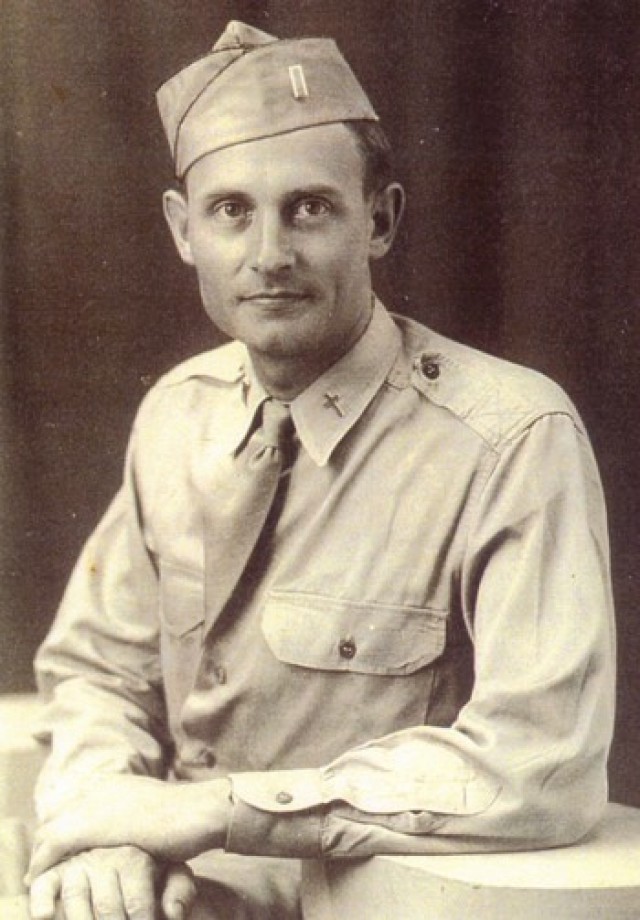
Chaplain (CPT) Emil Kapaun served as an Army Chaplain during World War II and the Korean War. He was born and raised on a small farm in Pilsen, Kansas. He exhibited a strong work ethic and service toward others while growing up in Pilsen. He helped his fellow neighbors harvest when they required support. His selfless service extended to his local church. He attended college and theological seminary and was ordained in 1940. When World War II broke out, he volunteered for service as an Army Chaplain. He believed he was called to serve in the military and serve the Soldiers in war. He would often go to the front lines to provide care and comfort to the men fighting at risk to his own life.
After World War II, he was discharged and attended Catholic University to earn a master’s degree. He served his local parish in Pilsen. He rejoined the Army and was stationed in Japan in 1950 when the Korean War broke out. During the war, he ran through enemy fire to drag wounded Soldiers to safety. He moved among foxholes under direct enemy fire to provide comfort and aid to fellow Soldiers. He became a prisoner of war, but his heroism and resilient spirit never wavered under harsh conditions. With disregard for his own well-being, he provided support to other Soldiers imprisoned. At Pyoktong Prison, he faithfully served fellow prisoners by foraging around the camp for millet seeds, corn, and soybeans, and filling his pockets with them to distribute as food to other prisoners. He would gather Soldiers in the evening to provide religious services. The Chinese began a re-education program in 1951 designed to get the prisoners to renounce their faith and their countries. Father Kapaun actively resisted. While in prison, he became deathly sick and was believed to have died from malnutrition and starvation on May 6, 1951. Official reports cite pneumonia as the official cause of death. His remains were never recovered. Father Kapaun earned the Bronze Star and Distinguished Service Cross for his service during World War II and was posthumously awarded the Medal of Honor on April 11, 2013, for his heroic action in Korea.
“Army professionals contribute honorable service as they accomplish the mission, perform their duty, and live their lives making ethical decisions and taking ethical actions.” (ADP 6-22; 1-18)
How do we perform honorable service?
I believe that how we serve in our profession depends greatly on our individual character. Character is that composition within us that consists of our moral and ethical qualities. These shape and reflect in our behavior, showing our level of integrity, honesty, and responsibility. “Character consists of their (Army leaders) true nature guided by their conscience, which affects their moral attitudes and actions.” (Ibid., 2-1) The Army strives to guide each Soldier’s character by the Army Values – Loyalty, Duty, Respect, Selfless Service, Honor, Integrity, and Personal Courage. It is our responsibility to align with these values to perform honorable service in our profession. A specified task within the Army is to develop our individual character to align with the Army Values and to perform honorable service.
Character development requires daily mindfulness and introspection. We can glean from others with good moral character and emulate those virtues we see in them. We can see in our own daily interactions how our own character shows up in the things that we say, think, and act upon. We should challenge ourselves to make the necessary changes to improve our character.
A fable by Aesop…
A Soldier cared for his Horse. So long as there was war, he fed him carefully and treated him as almost an equal. But, when the war ended, the Soldier only gave him chaff to eat and made him carry heavy loads; he treated the Horse badly. After a while, war was again declared, and both Soldier and Horse were called to duty. The Soldier put military trappings on the horse and mounted, clad in a coat of mail. The Horse immediately fell under the weight. He said to his master: “You must now go to war on foot, for you have changed me from a Horse to an Ass and you cannot expect me to change back in a moment.” [The Soldier and His Horse, Aesop Fable]
The point of this fable concerning honorable service is that we shouldn’t expect to perform military service with great character if we don’t live out our private lives daily with great character. We must live consistently when it comes to the Army Values, the Warrior Ethos. We need to commit daily to living out a moral and ethical life. These need to be evident within us both while on duty and off duty.
I am reminded by a statement Paul gave to the Philippian church:
“And now, dear brothers and sisters, one final thing. Fix your thoughts on what is true, honorable, and right, and pure, and lovely, and admirable. Think about things that are excellent and worthy of praise. Keep putting into practice all you learned and received from me—everything you heard from me and saw me doing. Then the God of peace will be with you.” (Philippians 4:8-9; New Living Translation)
Let us commit to live honorably with good character every day of our lives, no matter where we are and what we are doing.
 Chaplain Cavazos Blog
Leave a comment